Wednesday, April 7, 2010

The Future of the Internet


The Human civilization has come up with many kinds of technologies to make life easier. These technologies evolved to accommodate th ever-changing needs of humans. The wheels for example changed from solid wood blocks to the steel and rubber tyres we use today for our cars. This evolution however took a long time, CENTURIES to complete and even today, new and improved ways of making the perfect kind of wheel for our trains, planes and cars are developed everyday.

The Internet however, is a very recent tool in the Human toolkit. It has just passed it 40th birthday a year ago. I feel it is safe to say that nothing has evolved as fast as the internet has. Before our own eyes, we have seen the Internet changing from official use to public use.

Even in the past fifteen years or so, it has completely reinvented itself; arguably several times. Now we not only shop, bank, work and meet people online; but we share what we are doing at any given moment (e.g. Twitter), and even keep statistics on daily minutia. We read, listen and watch everything. We Digg, rate, share and favorite content daily. So what’s next?

Here's a video of Google's view on the Internet of Tomorrow:


I know, not as interesting as the videos showed in class by Mr. Choy! So, how about this video?


I know that this video has been shared in class, but I thought that it is an apt and precise video which is interesting as well! Hope you enjoyed it!

Friday, March 26, 2010

Journalism and Internet


Whenever we talk about the Internet in relation with Journalism, we describe the advantages of the concept. We talk about how journalism has evolved from being a two sector business, which involved the journalists and the readers, to being a single entity where everyone is writing as well as reading, where everyone is a prosumer. However, have we ever thought about its negative impacts? Have we ever thought that the internet may be hurting journalism more than helping it? According to an article in the Atlantic, the answer is the latter. Internet is hurting journalism more than it is helping it.

Here is the article for everyone to enjoy. This may actually help us all to understand the negative impacts of the internet on journalism. It sure did help me!!


Media Insiders Say Internet Hurts Journalism

As more readers consume news on the Net, media elites worry their industry is changing for the worse. Meantime, press coverage of President Obama, they say, is “about right.”

By Cyra Master

In a poll of prominent members of the national news media, nearly two-thirds say the Internet is hurting journalism more than it is helping. The poll, conducted by The Atlantic and National Journal, asked 43 media insiders whether, on balance, journalism has been helped more or hurt more by the rise of news consumption online. Sixty-five percent said journalism has been hurt more, while 34 percent said it has been helped more.

The media insiders were also asked about coverage of President Obama. Of 45 respondents, 71 percent say it has been “about right,” 22 percent say it’s been “too easy” and 7 percent say it has been “too tough.”

Those who say that news consumption on the Internet is, on balance, hurting journalism note the way the online experience is changing reader habits.The “hurt more” group also says that while the Internet offers benefits, the cost to traditional media and news-gathering is too high.

“The Internet has some plusses: It has widened the circle of those participating in the national debate. But it has mortally wounded the financial structure of the news business so that the cost of doing challenging, independent reporting has become all but prohibitive all over the world. It has blurred the line between opinion and fact and created a dynamic in which extreme thought flourishes while balanced judgment is imperiled.”

“A year ago, I would have given a different answer. The increases in audience reach and communication with the audience are incredibly gratifying. But the cost to the business model (R.I.P. Seattle P-I) and the inability of the business model to monetize the Internet means that there is a disturbing net cost to newsgathering. If you're not covering your state delegation in D.C., or the state legislature back home, or the city council, bad things are going to happen, undiscovered.”

“News consumption depends on news production, and I don't see anything on the Internet that produces news—that is, detailed responsible empirical journalism—the way newspapers do (or did). It is typical of Americans to get more excited about consumption than about production.”

“The Internet trains readers to consume news in ever-smaller bites. This is a disaster for newspapers and magazines.”

Those who say that news consumption on the Internet is helping journalism point to the range of information available online and to the way the Web has opened the practice of journalism to more people.

“Sure there's sludge, and I can feel overwhelmed by quantity--but the range and quality of what’s at my fingertips every morning is astonishing.”

“You abandon the conceit that ‘newspapers’ equals ‘news,’ you realize that people have far more information available to them about current events than ever before, and that’s a great thing for both journalism (the gathering of news) and the public.”

“It’s been bad in some ways for the media industry—especially newspapers, at this point—but over the long haul, I think the shift to the Web has helped the practice of journalism. It’s subjected journalists to more real-time scrutiny and opened the profession to talented people not affiliated with major media organizations.”

“More sources more often = good for the First Amendment. The creative aspects of creative destruction almost always represent progress. Nonetheless I worry about the death of expensive reporting and the professional standards that grew up by historical accident in the postwar period of licensed airwaves and quasi-monopolistic newspapers.”

As for coverage of President Obama, most members of the national media surveyed believe their peers have got it just about right.

The honeymoon period was more intense than usual (due to the historic character of Obama's win) but also shorter (due to unusually determined and early GOP opposition).”

“Some has been pointlessly skeptical—e.g., raising the question, ‘Is the president overexposed?’ But most has been correct, and some has been making up for skepticism that should have been applied during the campaign.”

But even the “about right” crowd has concerns.

“I guess the coverage has been about right, in the sense that it has been about as it always is: too superficial, too consumed with transitory back-and-forth, not searching enough, and often faintly hysterical in tone. It could certainly be better.”

“So far, there seems to be a balance between sympathy/admiration for Obama the man and the political leader, on the one hand, and the D.C. political community’s near-irresistible pull toward micro-coverage (scandal, poll readings, up-and-down) on the other. In the long run, I think and fear that the latter tendency will prevail, as it generally does. The magnitude of the issues being faced could, however, direct more attention toward big questions.”

Those who say coverage of Obama has been “too easy” believe the press is not doing its job.

“Not just too easy, but far too easy. Embarrassingly easy. Fawning. The worst ever in my lifetime.”

“I think we’re seeing the same phenomenon in media coverage we saw in coverage of Bush after 9/11—a dearth of clear-headed reporting that helps readers understand the potential near-term and long-term consequences of policy decisions being taken today. I can’t help but think that several years from now people will be wondering why reporters weren’t really pressing the administration much harder about policies that will expand the national debt and deficit to unprecedented levels. The consequences have economic, security, and social implications, which have only been superficially explored in coverage I’ve seen.”

And the three respondents who say “too tough” blame the media for being reflexively antagonistic.

“There is a bit of overcompensation from the positive campaign coverage, but even more there is the natural tendency of political reporting to overvalue (by an amount made greater with the influence of bloggers) the impact of any development, especially a negative development.”

“The coverage is too tough in a shallow way—it is relentlessly negative but also relentlessly petty, rather than deeply probing. It lacks a sense of history and context, and an appreciation for the complications of taking over the reins of government.”

Friday, March 19, 2010

How Obama’s Internet Campaign Changed Politics


The Internet has changed many facets of our life but who would have thought that it would completely revamp the ways of politics today. Obama, a great visionary, used internet to his advantage very well.

My friend and I were discussing the new internet boom in politics when he said that:

The ability of Obama to raise massive amounts of cash without having to spend wasteful time fundraising was key to his 50 state strategy. The next revolution is the ability of local politicians to get nationwide support from members of their own party – just as Tinklenberg got when he almost defeated Michelle Bachman in Minn. A lot of people with $20 to $50 to give can be a very powerful thing.

This idea of masses being a very powerful thing is very true. As Mr. Choy says in his classes, Obama was smart enough to know that with internet he can appeal to the masses and did not need to find support from three or four heavy financiers but can depend on the meager amount the masses can fish out. This is because 1 dollar from a million people is more effective than a million dollar from one investor. As with the one dollar, Obama is ensuring more awareness for his campaign. In effect, Obama managed to kill two birds with one stone as along with gathering finances, he also gathered support from the public.

However, there are those opposed to this way of politics and say that:

Don’t mistakenly assume the Internet will be ‘interactive’ with allthingsbarack dot com. The ‘communication’ will continue to be one-way, Obama to America, as in adaptive propaganda. The social impact will be like untreated creeping ick on tropical fish.

The only saving grace will be that those convinced by Dr. Frankenstein (Axelrod) that their self-image, -esteem, and -worth are barack-enhanced will be the first to turn on Obama, when post-election governing reality sets in, and the real Obama cannot fulfull all the hopes, dreams, and ambitions invited onto him via the nebulous ‘Yes We Can’.

I know it is a long video, but it effectively summarize the point I am trying to make here.


Ultimately, it is upon us to decide what we think about the effects of Internet on Politics.


Friday, March 5, 2010

Internet Multimedia: NewsML


NewsML is an XML standard designed to provide a media-independent, structural framework for multi-media news. NewsML was developed by — and is a registered trademark of — theIPTC. It is structure based, leaving layout and other presentational features to style sheets and other presentation languages such as XHTML or SMIL.It has also been adopted as Japanese Industry Standard (JIS) X7201:2005.

Although superseded in 2008 by NewsML-G2, NewsML 1 (as the original NewsML is now known) remains popular outside North America (especially in Asia) and is still supported by the IPTC.

NewsML 1 is the first design of the NewsML approach to exchange news. It was adopted by big news agencies around the globe and is still in use.NewsML 1 was released first in 2000, the current version is 1.2 of 2003. NewsML 1.x versions can be applied at all stages in the (electronic) news lifecycle.

Typical use would include:

  • in and between editorial systems
  • between news agencies and their customers
  • between publishers and news aggregators
  • and between news service providers and end users.

Because it is intended for use in electronic production, delivery and archiving it does not include specific provision for traditional paper-based publishing, though formats intended for this purpose - such as the News Industry Text Format (NITF)- can be accommodated. Similarly it is not primarily intended for use in editing or creating news content, though it may be used as a basis for systems doing this.

News exchange is a method of conveying not only the core news content, but also data that describe th content in an abstract way, information about how to handle news in an appropriate way, information about the packaging of news information, and finally information about the technical transfer itself.

As I am not a full time student of Computers, I was not privy to these technical details. Thanks to wikipedia and the IPTC Web I was able to compile this information and bring it out to everyone!

Friday, February 26, 2010

Internet Security

Until now, i have just mentioned the new useful innovations related to Internet, however, today I would discuss with you guys about the malignant threats consumers face by using these products.

When a computer connects to a network and begins communicating with other computers, it is essentially taking a risk. Internet security involves the protection of a computer's Internet account and files from intrusion of an unknown user.Basic security measures involve protection by well selected passwords, change of file permissions and back up of computer's data.

Cyber criminals are budding everywhere as they know that a successful attack can be very successful and profitable. Professional hackers are available today to hack into profiles of important companies and banks to get critical information and profit from them. This does not only affect the company or the bank but also their clients.

There are may types of cyber crimes. We have discussed a lot about it in the class. However, did you know that there is a special section of cyber crime in the Federal Bureau of Investigation (FBI). According to the FBI website, in the Cyber Investigations sections the FBI talks about its mission.

The FBI's cyber mission is four-fold: first and foremost, to stop those behind the most serious computer intrusions and the spread of malicious code; second, to identify and thwart online sexual predators who use the Internet to meet and exploit children and to produce, possess, or share child pornography; third, to counteract operations that target U.S. intellectual property, endangering our national security and competitiveness; and fourth, to dismantle national and transnational organized criminal enterprises engaging in Internet fraud. Pursuant to the National Strategy to Secure Cyberspace signed by the President, the Department of Justice and the FBI lead the national effort to investigate and prosecute cyber crime.

When I browsed through the website, I found out that there are ways in which we can complain about cyber crime online with just a click on the 'File an Internet crime complaint'. Also, the website gives us information on how to protect our computers from these crimes. Along with it, the site also fishes out useful information on New E-Scams & Warnings, Common Internet Frauds, Risks of Peer-to-Peer Networks, Parent’s Guide to Internet Safety, and More Protections.

It does not end there! Besides these features, the site also gives information on online crime statistics, the FBI online security surveys etc. This site ensures me that the case of online crimes is not hopeless and that there are fores out there who are bent on protecting others from the vicious criminals who may not directly or physically harm others but may still do great damage!


This will educate us as consumers to be better prepared to avoid such cyber crimes!
the FBI Fight Cyber Crime?

Friday, February 12, 2010

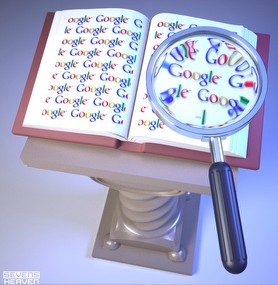
Google Books!


Google Books!
Bookmark, Organize, Share

Google Books is a service from Google that allow users to conduct searches throughout the full text of books that Google scans, converts to text using optical character recognition, and stores in its digital database.

When relevant to a user's keyword search, up to three results from the Google Books index are displayed above search results in the Google Web Search service (google.com). A user may also search just for books at the dedicated Google Books service. Clicking a result from Google Books opens an interface in which the user may view pages from the book as well as content-related advertisements and links to the publisher's website and booksellers. Through a variety of access limitations and security measures, some based on user-tracking, Google limits the number of viewable pages and attempts to prevent page printing and text copying of material under copyright.

Google Books are becoming more popular as its database continues to grow.By March 2007, Google had digitized one million books, according to The New York Times at an estimated cost of USD 5 million and by October 9, 2009, Google announced that the number of scanned books is over ten million!

Google has its own "Google Books Library Project" which is an enhanced card catalog of the world's books. Google is working with several major libraries to include their collections in Google Books and, like a card catalog, show users information about the book, and in many cases, a few snippets - a few sentences to display the search term in context.

When you click on a search result for a book from the Library Project, you'll see basic bibliographic information about the book, and in many cases, a few snippets – a few sentences showing your search term in context. If the book is out of copyright, you’ll be able to view and download the entire book. In all cases, you'll see links directing you to online bookstores where you can buy the book and libraries where you can borrow it.

According to Google, The Library Project's aim is simple: make it easier for people to find relevant books – specifically, books they wouldn't find any other way such as those that are out of print – while carefully respecting authors' and publishers' copyrights. Our ultimate goal is to work with publishers and libraries to create a comprehensive, searchable, virtual card catalog of all books in all languages that helps users discover new books and publishers discover new readers.

I hope this was interesting information for you guys! As i LOVE reading books, Google books is something which after some time may make it a hundred time more easier to find the books I want.

Saturday, February 6, 2010

E-Learning for Kids


Like the society and business, the field of education has also benefited a lot from the introduction of Internet to the public. Today, with the introduction of Google Documents, it has become really easy to share your documents or write one together. Along with that there are online courses; universities provide which students can complete within a semester in the comforts of their homes. Also, there are online courses available which allows students the liberty to be in another country altogether and still learn the same things that other students all over the world are learning!

However, online education does not only pertain to students who are from high-school and above. Younger children who are in their Kindergarten also have the option available to them and their parents. Internet makes it a lot livelier to teach children may it be from a site or taking contents from a particular sites and using it in the physical classroom.

According to the website 'e-learning for kids':

"In today’s complex world, children’s futures are determined by their ability to master the basics of reading, science, math and computers. Yet costs, class sizes and other issues often prevent children access to quality online learning that can support and reinforce these essential skills.

Our vision is to be the source for childhood learning on the Internet – available from anywhere and without charge. Established in late 2004, e-Learning for Kids is a global, nonprofit foundation dedicated to fun and free learning on the Internet for children ages 5 - 12. We offer free, best-in-class courseware in math, science, reading and keyboarding; and we’re building a community for parents and educators to share innovations and insights in childhood education.

E-learning for Kids isn’t only for kids, though; it’s also a site where:

  • Parents get more engaged in their kids’ education
  • Educators and experts champion e-learning and contribute their knowledge on how kids can learn better.
  • Commercial education and game developers contribute to the next generation.
  • Corporations and associations channel their social responsibility efforts.
  • People with a passion for childhood education make a difference.

Programs are designed for children ages 5 through 12, developed by leading e-learning vendors and qualified instructional designers, and reviewed by members of the Advisory Board and Quality Assurance teams. Schools can incorporate our tested online courses into their curriculum; teachers can work with their students on specific skills; and children can access the self-paced programs independently. The programs are designed to engage children at the level where they can perform successfully.

Videos like the one given below can really get the message across to kids which are the key factor of key learning.

Reference: http://www.e-learningforkids.org/aboutus.html


Tuesday, January 26, 2010

E-Commerce... Attracting Customers!!!


Along with the Social media websites, businesses with online commerce is also taking the cream off the internet! From Amazon to eBay, there are online markets appearing everywhere! So what is e-commerce? As we learnt in class, E-commerce involves digitally enabled commercial transactions between and among organizations and individuals.

E-Commerce today is very helpful to both consumers and business. This is because of the SEVEN Unique Features Of E-Commerce as given in the table below.


I won't go into the details of these features as we have learnt them in the class but these features have made e-commerce very easy to use.

Now that we know what it is, lets find out what we need to do to attract consumers if we make our own e-commerce website.

Firstly, to attract consumers, we need have a precise idea of WHO our consumers are. Once we know who our consumers are and what would attract them, we start with our website.

In 1997, the American Management Association surveyed 3,500 of its members on the business use of the Internet and identified three human interface design issues among the top six obstacles to increased e-commerce: slow response time, lack of user friendliness, and poor web site design. Two years later, Anders reports these are still among the critical success factors for an e-commerce site. The primary factor in determining e-commerce user loyalty, according to Anders, is having a web site that is "user friendly and easy to navigate." The other leading success factors are good previous experience, fast response time, and relevant, frequently updated content.

Secondly, the web site should be human friendly so using a human interface design becomes a necessity to attract users. Designing the human interface to an e-commerce web site should focus on gaining the user's attention, orienting the user to the business that will be transacted, and retaining the user's attention. The goal is to achieve active participation by the user in the web site. This requires understanding how to extend the human perception of the business transaction in such a way that the computer, and thus the web site itself, becomes virtually transparent.

There are three components of a user interface design for software user interfaces that are still relevant for discussing or evaluating e-commerce web sites. First, there is the user's conceptual model that helps the user anticipate the effect of the input he/she provides to the web site. The second component is the information presented by the web site, which should be consistent with the user's conceptual model. Finally, there is the feedback provided by the web site in response to user input.

To learn more about conceptual model, please visit the website: http://www.acm.org/crossroads/xrds7-1/ecuser.html

Information presentation is also a very big factor in attracting consumers. The look and feel of an e-commerce website should be based on the user requirement. The layout of the page should not only be easy to understand, it should also be attractive and sophisticated. Attractive features such as colorful pictures, videos etc should be added. However, if videos are added make sure that there is a mute and stop/pause feature in the video so that the user can interrupt the video whenever he/she wants to. Also, overuse of these attractive pictures may put off the users so avoid using them. Don't use clashing and too bright colors as they might make your site loose its credibility.

Along with the layout, the information included should also be concise and easy to understand. Include the information in a "flat hierarchy" which means that hierarchy of information should be apparent at a glance so the user easily understands the information available on a page.

Feedback is another important feature in your website. The interactive cycle between a user and a web site is not complete until the web site responds to a command entered by the user. A lag in loading a page or a blank page would result in skewing of the user's perception. This could mean a loss of the particular user. Finally, feedback should not distract the user. Actions and reactions made by the web site should be meaningful. Feedback should not draw the user's attention away from the important tasks of gathering information, selecting products, and placing orders.

There you go! Successful website building is related not only to your product and consumer profile, it also depends on the website layout and the feedback!

Here is a great video which effectively summarizes and adds to my points in the blog above!